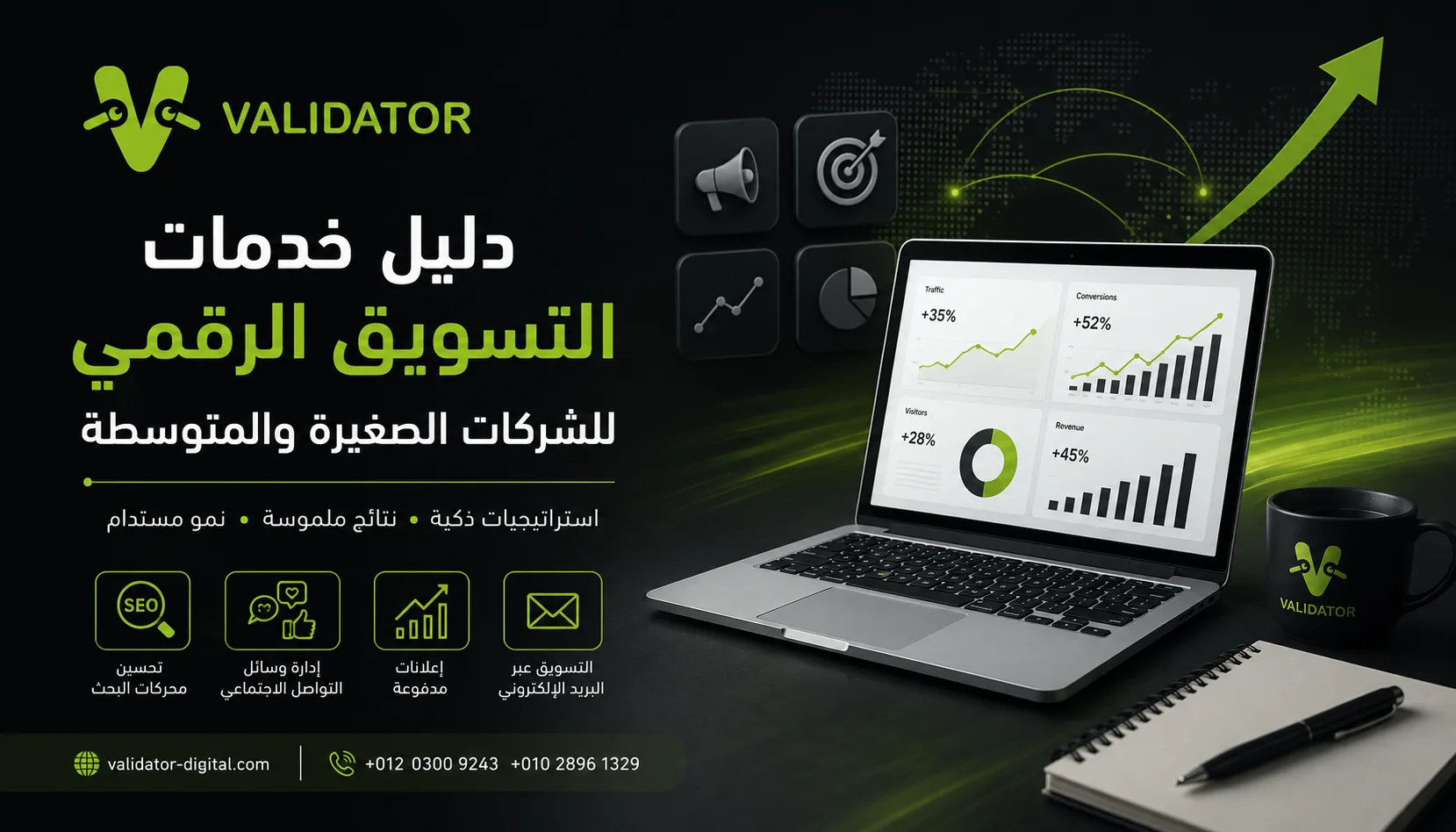
Today, small and medium-sized enterprises (SMEs) do not suffer from a lack of marketing options, but rather from an abundance of them.
Every day, a new platform, tool, or service emerges, claiming it can double sales and attract customers.
Amidst this flood of options, it becomes challenging to identify what is truly worth investing in and what can be postponed without hurting the company's growth.
Digital marketing is not about executing the highest number of activities; it is about choosing the right activities at the right time.
One company might achieve excellent results on a limited budget because it focused on the right channels, while another spends many times that amount without achieving the desired impact because it started in the wrong place.
Therefore, understanding digital marketing services is an essential step for any company looking to expand, increase sales, and build a strong market presence.
When you know the function of each service and how it integrates with others, decision-making becomes easier.
Your marketing budget then transforms from a mere expense into an investment yielding a real return.
In this guide from Validator, we highlight the most critical digital marketing services SMEs need, how to choose what fits your goals and business growth stage, and the criteria that help you select a digital marketing agency capable of delivering measurable results rather than just running marketing campaigns.
Why Digital Marketing Has Become a Necessity for SMEs
Years ago, companies could rely on traditional advertising or personal relationships to drive sales. Today, however, the majority of the customer journey begins online—whether searching for a product on Google, reading customer reviews, watching a video on social media, or comparing multiple brands before making a purchase decision.
Consequently, a digital presence is no longer an optional luxury; it is a fundamental pillar of a company's competitiveness. Even if your business relies on physical branches or direct sales, customers will likely search for you online before reaching out.
Digital marketing is uniquely crucial for SMEs because it gives them the opportunity to compete with larger corporations on smaller budgets—provided they rely on a sound strategy rather than random spending. Success does not depend solely on budget size, but on how deeply you understand your audience, choose the right channels, and continuously optimize performance.
What Are Digital Marketing Services?
Digital marketing services are a suite of activities and strategies that help businesses reach customers online, build long-term relationships with them, and convert that interest into sales, leads, or other business objectives.
No single service works in isolation. For example:
SEO might attract a visitor to your website.
Content convinces them to stay and read more.
A seamless User Experience (UX) helps complete the purchase.
Email Marketing nurtures the relationship and encourages repeat business.
This is why professional marketing agencies view a project as an integrated ecosystem, rather than just an ad campaign or a single social media post.
How Do You Know Which Services Your Business Actually Needs?
Before choosing any service, ask yourself:
Do customers already know my brand?
Do I need to increase brand awareness or boost sales?
Do I have a website ready to receive visitors?
Is the issue the volume of traffic or the conversion rate?
Do I need quick results, or am I building long-term growth?
Answering these questions helps prioritize your efforts, preventing wasted time and budget on services that might be good but are not the right fit for your current stage.
The Most Important Digital Marketing Services for SMEs
1. Search Engine Optimization (SEO)
SEO is one of the most sustainable long-term investments. It is not limited to placing keywords in articles; it includes optimizing site architecture, loading speed, user experience, content quality, internal linking, and technical aspects that help search engines understand and rank pages better.
The Key Advantage: It attracts visitors with high purchase intent, making this traffic much higher quality compared to many other channels.
2. Social Media Management
Professional social media management begins with studying the target audience, choosing the right type of content for each platform, setting a clear publishing schedule, and continuously analyzing results.
The Goal: It is not just to increase followers, but to build an active community around the brand, foster trust, and turn followers into customers.
3. Content Marketing
When you provide useful content tailored to your audience's needs, you do not just increase your search engine visibility; you also build a mental image that makes customers more willing to do business with you.
The Strategy: Successful companies rely on articles, guides, videos, infographics, and case studies as trust-building tools, not just informational posts.
4. Search Engine Marketing (SEM)
In some cases, you cannot wait for organic search results, especially when launching a new product or entering a competitive market.
This is where paid search engine advertising comes in, allowing you to reach customers the exact moment they search for your service.
The Key to Success: Success does not depend on budget size, but on selecting the right keywords, writing compelling ad copy, and designing high-converting landing pages.
5. Web Development
A website is not just an informational storefront; it is one of your most critical sales tools.
Even the best marketing campaigns can fail if the website is slow, not mobile-friendly, or hard to navigate.
The Standard: A website must combine professional design, fast performance, ease of use, and security, while optimizing the user experience from the very first visit.
6. Email Marketing
Despite the constant emergence of new platforms, email marketing remains one of the highest-ROI marketing channels when executed correctly.
You are communicating with people who have already shown interest in your products, rather than a cold audience.
The Modern Approach: Successful companies segment their audience and send personalized messages based on user behavior (e.g., new visitors, repeat customers, or abandoned cart users) to maximize open and conversion rates.
7. E-commerce Optimization
If you own an online store, increasing traffic alone does not guarantee more sales.
E-commerce success depends on details like site speed, searchability, clear product pages, multiple payment options, and a seamless checkout process.
The Journey: Specialized agencies treat an online store as an end-to-end journey starting from the first visit and extending to after-sales service, turning satisfied customers into brand advocates.
8. Branding
Two companies might sell the exact same product at nearly the same price, yet customers consistently choose one over the other.
The reason is often brand strength. Branding is not just a logo or colors; it is the overall impression a customer forms every time they interact with your company.
The Impact: A strong brand makes purchase decisions easier, increases customer loyalty, and decreases price sensitivity.
9. User Interface & User Experience (UI/UX) Design
Many companies focus on how a website or app looks but ignore how easy it is to use.
A customer does not care how beautiful a design is if they need several minutes to find what they are looking for.
The Focus: UI/UX design focuses on removing any barriers that prevent customers from reaching their goals quickly, reducing hesitation, and boosting conversion rates.
10. Mobile App Development & App Store Optimization (ASO)
For businesses that rely on apps, launching a great app is not enough; competition within app stores is fierce.
ASO aims to increase the app's organic visibility and downloads in the App Store and Google Play.
The Process: This involves choosing the right keywords, optimizing the title and description, designing attractive screenshots, and analyzing user reviews to increase conversion rates.
Do You Need All These Services at the Same Time?
The short answer is no.
One of the most common mistakes is trying to do everything at once.
This approach drains budgets quickly and makes it incredibly difficult to measure results or identify which channels are actually working.
The most effective method is prioritizing based on your business stage:
Business Scenario
Recommended Priority Services
Just starting out
Brand identity creation, professional web development, and basic social media setup.
Have a website but low traffic
Search Engine Optimization (SEO) and Content Marketing.
Need quick, immediate sales
Paid Advertising (SEM & Social Ads) while building organic channels for the future.
This way, every marketing investment becomes part of a clear, structured plan rather than just a random monthly experiment.
How to Choose the Right Digital Marketing Agency?
Choosing a marketing agency is just as important as choosing the services themselves, as execution quality determines the final outcome.
When evaluating an agency, ask about their methodology before asking about pricing:
Do they start by understanding your business?
Do they study your competitors?
Do they set measurable goals?
Do they provide clear, easy-to-understand reports?
Do they explain the reasoning behind every marketing decision?
If the answer is yes, you are dealing with a partner that views marketing as an ongoing process, not just a checklist of tasks.
Additionally, look for an agency's ability to integrate different services into a single strategy, as all digital marketing elements heavily influence one another.
Why Do Many Companies Rely on Validator as a Digital Growth Partner?
Instead of offering isolated, disjointed services, Validator relies on a methodology that begins with understanding your business, analyzing the market, and studying competitors.
We then build a clear strategy with measurable goals before moving on to execution and continuous optimization.
The agency provides a comprehensive suite of services including:
Search Engine Optimization (SEO) & Search Engine Marketing (SEM)
Social Media Management & Content Marketing
Email Marketing & Web Development
UI/UX Design & Mobile App Development
App Store Optimization (ASO)
Branding & E-commerce Solutions
Graphic Design & Motion Graphics
What sets this approach apart is that all services operate within a single, cohesive strategy driven by data analysis, KPI tracking, and continuous development—all aimed at achieving measurable growth rather than just inflating vanity metrics like views or likes.
How Can Your Company Start Its Digital Marketing Journey the Right Way?
If you own a small or medium-sized business, do not make your first decision the purchase of a marketing service. Instead, let your first step be understanding your company's current status.
Set Clear, Measurable Goals: Do you want to increase sales? Build brand awareness? Acquire new customers, or improve retention rates? Clear goals make choosing services easier and success tracking more accurate.
Review Your Current Digital Footprint: Is your website fast? Does it appear in search results? Do your social media pages look professional? Is your messaging consistent?
Focus on Bottom-Line Metrics: Do not rely on "likes" or impressions. Focus on metrics directly tied to your business growth, such as lead volume, Customer Acquisition Cost (CAC), conversion rate, and Return on Investment (ROI).
How Validator Transforms Marketing into a Tool for Growth
Validator adopts a unique philosophy: the success of any campaign begins long before execution.
Therefore, the agency does not jump straight into designing ads or writing content. Instead, we begin by deeply understanding the nature of your business, studying your goals, analyzing your target audience, and monitoring competitors to uncover high-impact opportunities.
Next, we construct an integrated strategy combining the digital channels best suited to your business, ensuring they all work in tandem under a single, cohesive plan.
This methodology relies entirely on data-driven decisions and regular optimizations to boost ROI, rather than guesswork or off-the-shelf templates.
Furthermore, we are committed to building long-term partnerships with our clients by providing clear reporting, absolute transparency in results, and evolving the strategy as your business needs grow—ensuring sustainable, real-world growth.
Frequently Asked Questions (FAQs)
What are the most important digital marketing services for SMEs?
The most critical services include SEO, Social Media Management, Content Marketing, Paid Advertising, Web Development, and Email Marketing. Choosing the right service depends entirely on your business goals and current growth stage.
Does a startup need all digital marketing services?
No, it is best to start with services that address your current priorities, then gradually expand as your business and budget grow, rather than investing in all channels simultaneously.
How do I choose the right digital marketing agency?
Look for an agency that relies on data analysis, sets measurable goals, and provides a clear strategy along with regular reports, backed by proven experience in running campaigns tailored to your industry.
When do digital marketing results show?
Timeline varies by service. Paid ads can yield results within days, whereas SEO and content marketing typically require several months to deliver sustainable, organic growth in traffic and leads.
Why is working with a full-service agency better than hiring multiple service providers?
Because a full-service agency coordinates all marketing channels under a single strategy. This ensures consistent brand messaging, optimized cross-channel performance, a higher ROI, and much easier performance tracking.
Need this applied to your business?
Let’s validate your next move.
Share a few details and our team will recommend the fastest path to measurable growth.