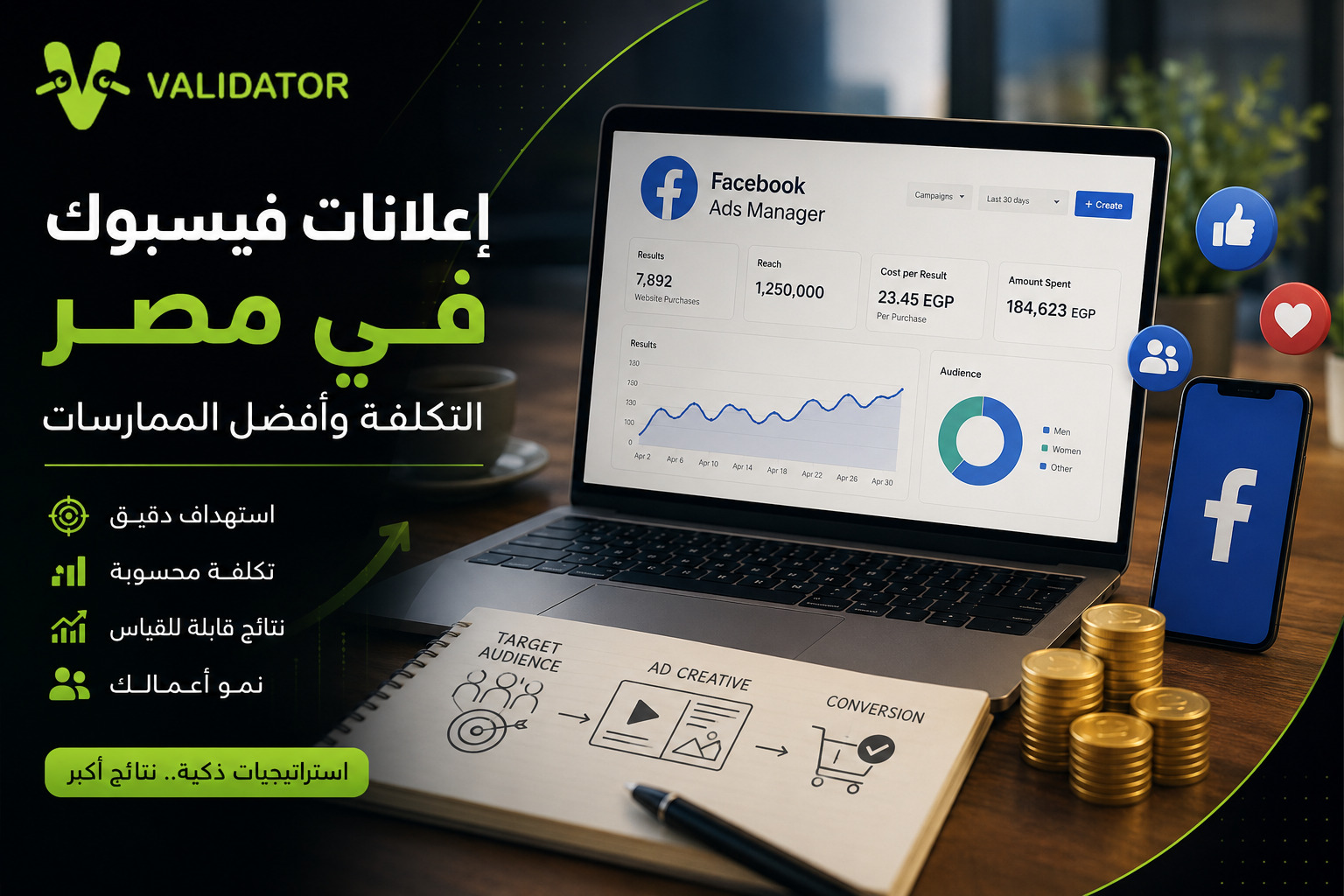
If you own a business, an e-commerce store, a clinic, a restaurant, or even offer a local service, it's hard to ignore the scale of opportunities provided by Facebook ads today.
Millions of Egyptians use Facebook and Instagram daily, making reaching potential customers faster and more precise compared to traditional advertising methods.
However, the reality that many business owners discover after launching their first campaign is that budget alone is not enough to achieve results.
One person might spend thousands of pounds without generating real sales, while a competitor achieves better results with a smaller budget.
The secret lies not in the amount spent, but in how the campaign is managed, the quality of targeting, and how well the ad aligns with the audience's needs.
For this reason, many are looking for clear answers to two basic questions: How much do Facebook ads cost in Egypt? And how can you get the best return from your available budget? In this guide, you will learn about the factors that determine ad costs, how to allocate your budget smartly, and the key practices that help increase sales and reduce customer acquisition costs.
How Much Do Facebook Ads Cost in Egypt?
There is no fixed cost that applies to all campaigns. Facebook ads work on an auction system, meaning advertisers compete to reach the same audience; therefore, prices vary from one campaign to another.
Some daily campaigns can start with a modest budget of 100 or 200 EGP, while campaigns targeting tough competition need larger budgets to achieve tangible results. In all cases, the success of a campaign should not be evaluated based on the spending amount alone, but according to the return generated for every pound spent.
For example, a campaign costing 500 EGP might generate dozens of potential leads, while another campaign spends 3,000 EGP without achieving the desired results due to weak targeting or advertising copy.
Therefore, the most important question is not: How much will I pay? but rather: How much return will I generate for what I pay?
What Factors Determine Ad Costs?
Ad costs change constantly due to a group of factors, each of which can significantly raise or lower the cost.
Target Audience
The broader and correctly defined the audience is, the better the chances of getting a lower cost. However, if you are targeting a hyper-competitive or overly specific audience, the cost of reaching them may rise.
For example, targeting people interested in buying luxury real estate is completely different from targeting an audience looking for daily consumer goods.
Market Competition
Some sectors experience extremely strong competition, such as:
Real estate.
E-commerce.
Automotive.
Medical services.
Education.
The more companies target the same segment, the higher the auction price rises, thereby increasing the ad cost.
Ad Quality
Facebook doesn't only care about who pays more; it also cares about ad quality and how users interact with it.
An ad that gets a high Click-Through Rate (CTR) along with good comments, shares, and likes often enjoys a lower cost compared to an ad the audience doesn't engage with.
That is why design quality, a strong headline, and clear marketing messaging directly affect the overall campaign cost.
Campaign Objective
Costs vary depending on the objective you select inside Ads Manager.
For example:
Brand awareness campaigns differ from sales campaigns.
Messaging campaigns differ from website traffic campaigns.
Lead generation campaigns differ from app installation campaigns.
Each objective uses different algorithms to reach the people most likely to perform the desired action.
Landing Page Quality
If the ad leads the user to a slow website or an unclear landing page, conversion rates drop, requiring Facebook to spend a larger budget to achieve the same results.
Therefore, optimizing the website is just as important as optimizing the ad itself.
Does a Larger Budget Mean Better Results?
A common mistake is believing that increasing the budget automatically leads to increased sales.
In reality, if a campaign has flaws in targeting, content, or ad design, doubling the budget will often double your spend without improving results.
However, when a campaign is built on accurate data, testing multiple ads and audiences, even small budgets can deliver excellent results. Spend can then be increased gradually while maintaining the same performance level.
This is why successful companies rely on continuous testing and analysis before scaling their budget, not the other way around.
How to Allocate Your Ad Budget Smartly
Instead of spending your entire budget on a single ad, it is preferred to split it into several initial tests.
For example, you can test:
Multiple designs.
Multiple ad copies.
Multiple target audiences.
Multiple ad placements.
After a few days, the data becomes clear, allowing you to pause low-performing ads and scale the budget for the ads delivering the best results.
This approach minimizes risk and gives you a clearer view of what your audience actually prefers, rather than relying on guesswork.
When Do You Need Professional Facebook Ad Management?
Creating an ad campaign might seem simple, but achieving stable results requires expertise in data analysis, audience selection, copywriting, budget management, and continuous performance measurement.
This is why many businesses turn to specialized agencies that possess experience in managing digital campaigns through data-driven strategies rather than guesswork.
Among these agencies is Validator, a full-service digital marketing agency that relies on market and user behavior analysis to develop campaigns that achieve measurable growth. They provide integrated services including social media management, Search Engine Marketing (SEM), Search Engine Optimization (SEO), content marketing, website and app development, and other services supporting long-term campaign success.
Best Practices for Launching a Successful Facebook Ad Campaign
The success of an ad campaign doesn't start when you click "Publish"; it begins way before that. Every decision you make—from setting the objective to analyzing results—directly impacts ad cost and the number of customers you attract.
Below are the key practices professionals rely on to manage campaigns that yield real results:
1. Start with a Clear, Measurable Goal
One of the most common mistakes is launching a campaign without defining the desired outcome.
Ask yourself first:
Do you want to increase sales?
Collect potential customer data (leads)?
Increase website traffic?
Raise brand awareness?
Choosing the correct objective inside Facebook Ads Manager helps the algorithm display your ad to people most likely to perform your desired action, which improves performance and reduces costs.
2. Don't Target Everyone
Targeting a broad audience might seem like a good idea, but it often leads to wasting a large portion of your budget.
The right audience isn't the largest in number, but the most interested in what you offer.
Therefore, make sure to build an audience based on:
Geographical location.
Suitable age group.
Actual interests.
Purchasing behavior.
Job titles or fields when necessary.
Current customers and retargeting lists.
The more relevant the audience is to your service, the higher the chance of achieving better results.
3. Make the Ad Answer the Customer's Question
Users don't pause at an ad just because it looks nice, but because they found an answer to a problem or need they're looking for.
Therefore, focus on:
The pain point the customer experiences.
The solution you provide.
The edge that sets you apart from competitors.
A clear Call to Action (CTA).
Ads that speak the customer's language usually achieve higher engagement and conversion rates than ads that merely show the product.
4. Use Images and Videos That Grab Attention Quickly
Within a few seconds, users decide whether to keep watching an ad or scroll past it.
For this reason, visual content must be:
Clear.
High quality.
Show the product or service realistically.
Aligned with brand identity.
Short videos that showcase the core benefit immediately within the first few seconds generally achieve better view and engagement rates than long videos.
5. Test Multiple Ads Simultaneously
Even top marketing experts cannot predict the winning ad 100% of the time.
That's why they rely on A/B Testing by trying out multiple:
Headlines.
Images.
Videos.
Ad texts.
Call to Action buttons.
Target audiences.
After collecting data, low-performing ads are turned off, and budgets are allocated to top performers. This methodology lowers acquisition costs and improves ROI over time.
How to Reduce Facebook Ad Costs
Reducing costs doesn't simply mean cutting the budget; it means improving overall campaign efficiency.
Some of the most effective ways include:
Improving Ad Quality
The higher the engagement rate on an ad, the higher its quality score in Facebook's eyes, helping lower reach and click costs.
Relying on Retargeting
Not everyone who sees your ad will buy the first time.
However, retargeting people who:
Visited the website.
Watched the video.
Sent a message.
Added a product to the cart.
usually yields much higher conversion rates compared to targeting a completely cold audience.
Landing Page Optimization
If a customer clicks an ad only to land on a slow or confusing page, the conversion opportunity is lost regardless of how great the ad was.
Therefore, the landing page must feature:
Fast loading speed.
Clear information.
Easy ordering or contact process.
Full mobile responsiveness.
Daily Performance Tracking
Don't leave a campaign running for weeks without review.
Continuously monitor metrics such as:
Cost Per Click (CPC).
Click-Through Rate (CTR).
Cost Per Conversion.
Conversion Rate.
Return on Ad Spend (ROAS).
These figures help you spot issues early before exhausting your budget.
Mistakes That Waste Your Ad Budget
Even with a large budget, a campaign can fail due to simple yet impactful mistakes.
Key mistakes include:
Relying on a single audience: Restricting yourself to one audience deprives you of discovering segments that could deliver better results at lower costs.
Stopping the campaign too quickly: Facebook's algorithm requires a Learning Phase to gather sufficient data. Stopping an ad after just a few hours prevents the system from properly optimizing performance.
Constantly tweaking campaign settings: Making frequent adjustments to the budget, audience, or ads resets the campaign back to the learning phase, impacting result stability.
Ignoring comments and messages: Prompt interaction with potential clients increases sales conversions, whereas slow responses can lose customers to competitors.
Focusing solely on likes: An ad might get thousands of likes without generating a single sale. Campaign success must be measured by real business KPIs—like leads, sales, and ROI—not just vanity metrics.
How Do You Know If Your Campaign Is Truly Successful?
Campaign success is not measured solely by a lower cost-per-click, but by its ability to achieve core business goals.
Ask yourself after a campaign ends:
Did sales increase?
Did the number of potential leads grow?
Did customer acquisition become cheaper?
Did the campaign generate a return higher than the amount spent?
If the answer is yes, then the campaign is delivering true value to the business, rather than just impressive numbers on a dashboard.
Why Does Professional Facebook Ad Management Yield Better Results?
Anyone can launch an ad campaign in a matter of minutes, but managing a campaign that drives sustainable growth is completely different.
Success doesn't rely just on running the ad, but on a chain of decisions that start before launch and continue well after.
Professional management involves analyzing the market, studying competitors, understanding user behavior, selecting appropriate marketing messaging, and continuously tracking performance to make optimizations that boost ROI and cut acquisition costs.
This is why companies focused on genuine growth rely on partners who possess the expertise and tools required to make decisions based on data, not guesswork.
How Validator Helps You Achieve the Best Results from Facebook Ads
If you're looking for an agency to manage your ad campaigns with a clear methodology, Validator offers integrated solutions that help businesses achieve measurable digital growth by blending precise analysis, creativity, and continuous monitoring.
The workflow begins by analyzing your business, target audience, and competitors, then crafting a strategy tailored to your marketing goals—whether that's boosting sales, collecting leads, or building brand reach.
The agency operates on a transparent methodology: understanding and analysis, followed by planning, execution, and finally measuring and continuously optimizing performance.
Validator's services extend beyond Facebook ad management to offer a complete ecosystem including SEO, SEM, content marketing, social media management, email marketing, web and mobile app development, UI/UX design, branding, graphic design, and motion graphics—ensuring all marketing channels work together seamlessly.
What sets the agency apart is its reliance on data-driven strategies and decisions rooted in real market and user behavior analysis, paired with transparent performance reports so business owners know the exact return on every pound spent.
Are Facebook Ads Still Worth the Investment?
Despite the rise of new advertising platforms, Facebook and Instagram ads remain among the most powerful channels to reach customers in the Egyptian market, thanks to precise targeting options, diverse ad formats, and real-time performance tracking.
However, success is no longer about throwing more money at the platform, but about directing your budget to the right audience, testing different concepts, and evaluating results constantly. When managed correctly, ads become an investment driving real business growth, rather than just a marketing expense.
Launch Your Ad Campaign with Confidence alongside Validator
Whether you want to drive sales, reach more customers, or improve the return on your ad spend, Validator brings the expertise and tools necessary to build campaigns that deliver measurable outcomes.
From the initial strategy session to ongoing performance tracking and optimization, Validator's team acts as a growth partner, helping turn your ad spend into real opportunities for expansion and revenue growth.
You can contact the agency today for a free initial consultation and start building a strategy tailored to your business goals.
Frequently Asked Questions (FAQ)
What is the minimum budget for Facebook ads in Egypt?
Campaigns can start with small daily budgets, but the ideal budget depends on your campaign objective, level of market competition, and target audience.
Can I generate sales with a limited budget?
Yes, provided the campaign is built on accurate targeting and compelling ad content, backed by continuous performance tracking.
What factors influence ad costs?
Key factors include market competition, target audience, ad quality, marketing objective, and the efficiency of your landing page.
How long does it take to see campaign results?
It varies depending on your business type and goals, but campaigns typically need a few days to pass the Learning Phase before data starts showing accurately.
Is hiring a specialized agency better for managing campaigns?
In many cases, yes. Specialized agencies rely on data analysis, strategy testing, and ongoing optimization, which helps maximize ROAS and lower customer acquisition costs.
Need this applied to your business?
Let’s validate your next move.
Share a few details and our team will recommend the fastest path to measurable growth.